

Course teaching visuals
Thirty-eight teaching diagrams across eight modules. Each is placed alongside its relevant lesson or used as the matching lesson header.
Module 3 — Understanding the Mind of the Customer
Lesson 1
Open the lesson →
Lesson 2
Open the lesson →
Lesson 3
Open the lesson →
Lesson 4
Open the lesson →
Lesson 5
Open the lesson →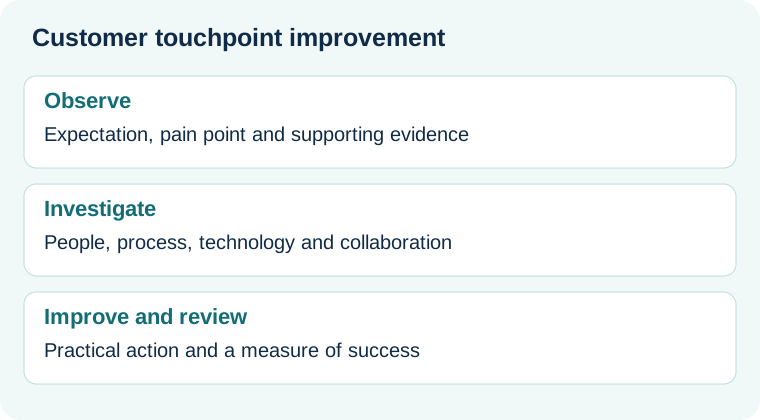
Module 5
Lesson 2: A handover the next person can use
Open the lesson →
Read the diagram text
A handover the next person can use. Give the next team enough context to act. Customer goal: What does the person need, and by when? Relevant facts: What is confirmed and what was checked? Next action: What remains unresolved? Accepted owner: Who has agreed to act? Update promise: When will the customer hear back? Share relevant information through approved channels. A transfer is not complete just because it was sent.
Lesson 3: Shared work. Clear ownership.
Open the lesson →
Read the diagram text
Shared work. Clear ownership.. Agree who investigates, who updates and who helps if blocked. Investigate: Warehouse checks the parcel status. Coordinate: Support records the current position and next step. Update: The agreed contact keeps the customer informed. Escalate if blocked: The responsible manager helps resolve the dependency. Ownership means an accepted next action, a realistic time and a clear handover—not one person doing everything.
Lesson 4: A local target can hide a journey problem
Open the lesson →
Read the diagram text
A local target can hide a journey problem. Review the result across teams as well as activity within them. Local view: Case closed quickly. Transfer sent. Team target met. Customer view: Issue unresolved. Another call. Story repeated. Shared review: Check repeat enquiries, handover quality and whether the customer can move forward. Keep useful operational measures, but interpret them alongside the end-to-end experience.
Lesson 5: Connect the information—not just the teams
Open the lesson →
Read the diagram text
Connect the information—not just the teams. Follow one item of information through the workflow. Record once: Where is the status created? Use the right source: Which version is current and reliable? Access appropriately: Can the receiving team see what it needs? Keep it current: Who updates changes and tells colleagues? Review guidance, permissions, systems and responsibilities together. Use approved access; never share passwords.
Lesson 6: Start a constructive cross-team conversation
Open the lesson →
Read the diagram text
Start a constructive cross-team conversation. Bring a real example and a shared customer goal. Describe: Here is what happens and how it affects customers. Ask: Can we follow one example together? Agree: Choose a small action, owner and approval. Review: Set a date and share what changed. Be curious about colleagues’ constraints. Evidence and shared purpose help the conversation move beyond blame.
Module 7
Lesson 2: From observation to a useful evidence statement
Open the lesson →
Read the diagram text
From observation to a useful evidence statement. Be specific about what you know—and what still needs checking. Obstacle: Support cannot see the parcel update. Customer impact: Customers chase an answer or repeat a call. Evidence: Review an approved sample and state its limits. Next question: How common is it, and where does the gap occur? Do not turn a small sample into a company-wide rate or invent a financial cost.
Lesson 3: Explore the cause before choosing a fix
Open the lesson →
Read the diagram text
Explore the cause before choosing a fix. An observation is a starting point, not a proven explanation. Observe: The receiving team cannot see the notes. Explore: Could access, guidance or the handover contribute? Check: Follow the workflow with colleagues and review evidence. Act and learn: Test an appropriate change and revisit the result. Ask “What makes this happen?” as a useful conversation, not a blame exercise or a fixed five-question script.
Lesson 4: Choose an improvement across three lenses
Open the lesson →
Read the diagram text
Choose an improvement across three lenses. A single obstacle may need more than one kind of change. People: Clarify guidance, skills and support. Process: Agree the handover, owner and timing. Technology: Check information access and system reliability. Connect the suggestion to the observed obstacle. Agree approval, a manageable test and a review before wider rollout.
Lesson 5: A recommendation reviewers can act on
Open the lesson →
Read the diagram text
A recommendation reviewers can act on. Describe the problem before proposing a solution. What happens?: The parcel status is missing after dispatch. Why it matters: Customers call again; support cannot give a clear answer. What may help: Review the warehouse-to-support handover. Who and how: Involve the relevant teams and check the result. Choose a primary category and add a different secondary category only if it helps. Leave out confidential information.
Lesson 6: Close the employee feedback loop
Open the lesson →
Read the diagram text
Close the employee feedback loop. Keep people informed about what happened to their suggestion. Acknowledge: Confirm the idea has been received. Investigate: Check evidence, cause and dependencies. Decide: Accept, adapt or defer—and explain why. Act: Agree an owner and a realistic review date. Share results: Explain the outcome and next step. This is the intended connected workflow. The course preview form saves locally only; it does not submit or issue tracking numbers.
Module 2
Lesson 2: What was promised? What actually happened?
Open the lesson →
Read the diagram text
What was promised? What actually happened?. Expectations influence how the same event is experienced. The expectation: “Delivery by Friday” sounds like an arrival promise. The reality: The warehouse treats Friday as dispatch day. Make it clearer: Separate dispatch, arrival estimates and the next update. Make realistic commitments and explain changes before customers have to chase.
Lesson 3: Recognise the feeling behind the request
Open the lesson →
Read the diagram text
Recognise the feeling behind the request. Use the customer’s words; do not assume everyone feels the same. Uncertainty: “Has my order gone through?” Concern: “I need it before Monday.” Reassurance: “I know what is confirmed and when I will hear back.” Illustrative experience, not a universal emotional sequence. Acknowledge the concern and connect it to practical help.
Lesson 4: Necessary checks. Less unnecessary effort.
Open the lesson →
Read the diagram text
Necessary checks. Less unnecessary effort.. Look beyond the number of steps in your own team. Avoidable effort: Retell the story, find another number, chase the update. A clearer route: Pass relevant context, explain required checks, agree the next step. Keep essential protections. Reduce duplication appropriately rather than bypassing security, safety or approval requirements.
Lesson 5: Bring customer evidence together
Open the lesson →
Read the diagram text
Bring customer evidence together. One source rarely explains the whole experience. Listen: Comments, questions, complaints and interviews. Observe: What people try to do and where they struggle. Check patterns: Relevant operational evidence and repeated themes. Investigate: Compare sources and consider whose views are missing. Keep customer words separate from interpretation, and share themes without unnecessary personal information.
Lesson 6: A response that helps the customer move forward
Open the lesson →
Read the diagram text
A response that helps the customer move forward. Connect the goal to a realistic next step. Understand: What does the person need, and why now? Explain: What is confirmed and what remains uncertain? Coordinate: Who will take the next accepted action? Update: When will the customer hear from us? Customers should not need to work out the organisation’s structure to get a clear answer.
Module 4
Lesson 2: Awareness: make a promise we can support
Open the lesson →
Read the diagram text
Awareness: make a promise we can support. The experience begins before the first conversation. First impression: Advert, search result, reputation or recommendation. Expectation: The customer forms a view of what we offer. Delivery check: Marketing and operations confirm the promise and its conditions. A strong message helps the right customer understand a realistic offer.
Lesson 3: Consideration: help the customer choose
Open the lesson →
Read the diagram text
Consideration: help the customer choose. Give people the information they need before committing. Suitability: Will this help me achieve my goal? Commitment: What is included, excluded and required? Consistency: Do the website, checkout and employee guidance agree? Clear, consistent information supports confident decisions and more reliable answers from employees.
Lesson 4: Purchase: confirm the completed step
Open the lesson →
Read the diagram text
Purchase: confirm the completed step. Do not make a pending step look like a finished outcome. Received: The request or order reached the organisation. Checked or paid: Say which step is actually complete. Next step: Explain remaining action, timing and how updates will arrive. Acknowledgement, payment and approval may be different events. Use the wording that accurately reflects your process.
Lesson 5: Use: help the customer succeed
Open the lesson →
Read the diagram text
Use: help the customer succeed. Payment is not the end of the experience. Get started: Clear access, setup and instructions. Use confidently: Reliable service and accurate information. Get help: A clear route to support and an effective handover. Ask whether the customer can achieve the goal they bought the product or service for.
Lesson 6: Loyalty: earn the next decision
Open the lesson →
Read the diagram text
Loyalty: earn the next decision. Review the accumulated experience, not just the next offer. Experience and value: Was the promise delivered and the product useful? Next decision: Return, renew, recommend—or reconsider. Learn: Review behaviour, feedback and unresolved issues. Price, circumstances and alternatives also influence decisions. Repeat purchase alone does not prove satisfaction.
Module 6
Lesson 2: Own it until it’s handed over
Open the lesson →
Read the diagram text
Own it until it’s handed over. Stay with the problem until a named person has accepted it. Hear it: Listen and check what the person needs. Find: Work out who can resolve it. Hand over: Share what’s known so nobody repeats their story. Confirm: A named person accepts it, and you say who. Ownership doesn’t mean doing everything yourself. Record the next step so a colleague can continue.
Lesson 3: Replace internal jargon with a clear next step
Open the lesson →
Read the diagram text
Replace internal jargon with a clear next step. The customer needs to understand the position, not our department names. Unclear: “Your matter has been escalated and is pending reconciliation.” Clearer: “The delivery team is checking the parcel location. I will update you by 3 pm, even if the check is ongoing.” Explain what is happening, what remains uncertain and when the customer should expect the next update.
Lesson 4: Walking past is a decision too
Open the lesson →
Read the diagram text
Walking past is a decision too. Leave spaces, records and work better for the next person. Notice: Spot what’s untidy, out of date or faulty. Fix: If it takes seconds and is safe, put it right. Report: If not, tell the owner through the right route. Pass it on: Hand work on complete, with problems flagged. The standard applies to everyone, not only the team whose job it is.
Lesson 5: Finished means the person knows it’s finished
Open the lesson →
Read the diagram text
Finished means the person knows it’s finished. Close every request with the person who raised it. Promise: Agree a realistic time for the next update. Update: Make contact as agreed, even without a final answer. Confirm: Tell them it’s done and check it works for them. Learn: Raise repeat problems for improvement. Closed on the system is not the same as closed with the person.
Lesson 6: Turn a bad moment around
Open the lesson →
Read the diagram text
Turn a bad moment around. Four steps that rebuild confidence when something goes wrong. Say it early: Tell people as soon as you know, in plain words. Apologise: For the effect on them, not the policy. Act: Do something they can see, within your authority. Follow through: Tell them it’s resolved or where it stands. Escalating quickly, with the full picture, isn’t failing. Know your limits before you need them.
Module 8
Lesson 2: Choose an achievable first priority
Open the lesson →
Read the diagram text
Choose an achievable first priority. Balance customer impact with the next step you can influence. Customer impact: What becomes easier or more reliable? Recurring pattern: Is it a repeated obstacle worth investigating? Practical next step: What can you do, and who must help? Raise wider dependencies through the appropriate route. Choosing one first step does not mean other concerns are unimportant.
Lesson 3: Turn an intention into a small action plan
Open the lesson →
Read the diagram text
Turn an intention into a small action plan. Make the work specific enough for a colleague to understand. Action and owner: What will happen, and who owns the next step? Support and approval: Who needs to help or authorise the change? Timing: When will it begin and be reviewed? Evidence: What would show whether it helped? Example: review one handover with the receiving team this week, agree an approved change and check the next two examples.
Lesson 4: Look beyond activity to the effect
Open the lesson →
Read the diagram text
Look beyond activity to the effect. Connect the change to customer behaviour and a useful outcome. Change: Make delivery updates clearer and more accurate. Customer behaviour: Check whether clarification enquiries change. Useful outcome: Less customer uncertainty and avoidable workload. Review context: Compare relevant volumes, feedback and other changes. This is a measurement question, not a guaranteed result or proof that the change caused every outcome.
Lesson 5: Six weeks to revisit and use the learning
Open the lesson →
Read the diagram text
Six weeks to revisit and use the learning. Short conversations can connect the course to everyday work. Weeks 1–2: Your contribution; the customer’s goal. Weeks 3–4: Join up handovers; put empathy into action. Weeks 5–6: Review an obstacle; revisit your commitment. The follow-up prompts are available as resources. No automatic email campaign is active in this preview.
Lesson 6: Review, share and begin the next cycle
Open the lesson →
Read the diagram text
Review, share and begin the next cycle. Use results to guide what happens next. Try: Take an approved practical action. Review: What changed, and what evidence supports it? Share: Explain results, uncertainty and remaining barriers. Continue: Sustain, adapt or investigate the next issue. At three months, revisit the action plan with the appropriate colleague or manager. Completion alone does not prove changed behaviour.
Module 1
Lesson 4: Frontstage and backstage: one experience
Open the lesson →
Read the diagram text
Frontstage and backstage: one experience. Visible conversations depend on work customers may never see. Frontstage: Explain, listen, guide and keep the customer informed. Backstage: Maintain accurate information, reliable systems, clear approvals and useful handovers. One customer outcome: Colleagues can give a clear answer and help the customer move forward. Everyone contributes through the work they do and the way they support the next team.
Lesson 5: The same claim, with less friction
Open the lesson →
Read the diagram text
The same claim, with less friction. An illustrative insurance scenario shows where the experience can improve. A frustrating route: Repeated documents, unclear updates and handovers without context. The customer must chase an answer. A more joined-up route: Appropriate document access, clear status information and an accepted next owner. The customer knows what happens next. Keep necessary checks and privacy protections. Investigate the process and information flow rather than blaming the customer.
Lesson 6: Your contribution can improve the whole experience
Open the lesson →
Read the diagram text
Your contribution can improve the whole experience. Start with one obstacle and involve the right people. People: Ask what support or clearer guidance would help. Process: Clarify the next step, handover and owner. Technology: Check access to accurate, useful information. Choose one realistic action within your influence, agree any approval needed and review whether it helps.